



 COPIED
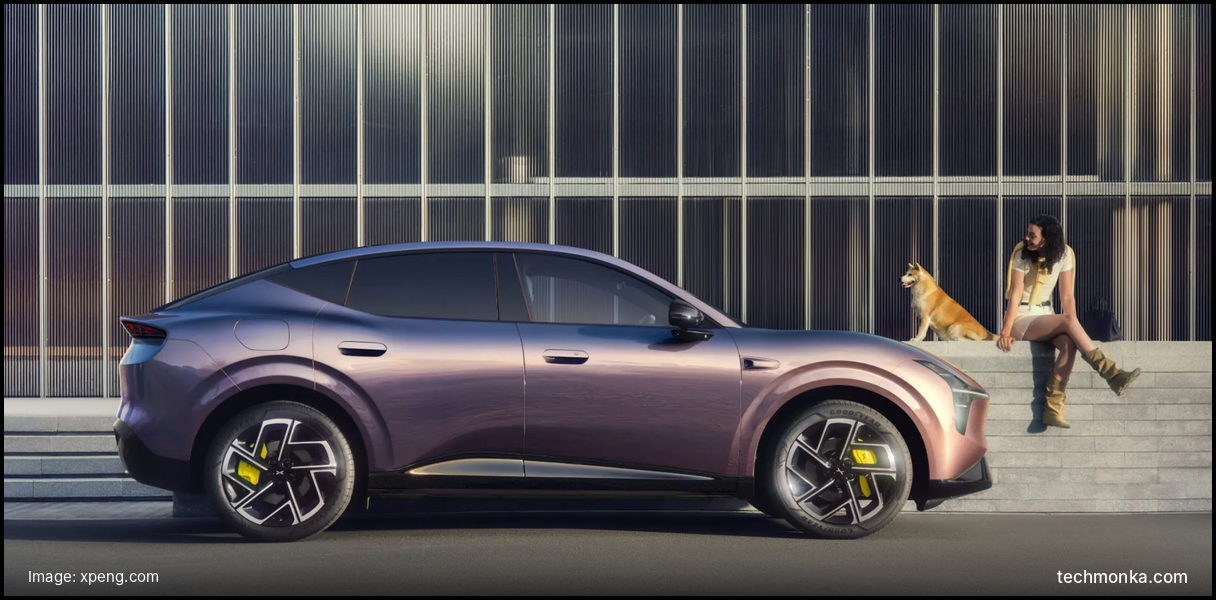
The first customer car in Europe was handed over in Paris on 13 October by Xpeng’s chairman and chief executive, He Xiaopeng, who used the trip to meet the company’s French dealer partners. According to Xpeng, the buyer chose the car mainly because of its driver-assistance technology, which is the part of the package the company most wants to talk about.
The L03, sold as the Mona L03 in China, is Xpeng’s first car to be launched in China and Europe at the same time. It was unveiled in Munich in July with plans to sell it in 65 countries and regions, and it went on sale in Australia and New Zealand earlier this month. In Germany it starts at €35,600, a little over €3,000 less than the cheapest Tesla Model Y.
Who is Xpeng?
Xpeng was founded in 2014 and is one of the younger names among China’s electric car makers, alongside Nio, Li Auto and Xiaomi. It has delivered more than 1.2 million cars, according to the company, and its overseas sales passed 10,000 in a single month for the first time in September. Volkswagen owns a stake in the business and the two firms are developing cars together for the Chinese market.
Where many rivals buy their self-driving hardware from Nvidia or Qualcomm, Xpeng designs its own chips and writes its own driving software, and the L03 is the cheapest way yet to get that technology outside China.
The AI chip under the skin
Most versions of the L03 carry Xpeng’s in-house Turing AI chip, which handles the heavy computing needed to make sense of what the car’s cameras see. The Max version uses one chip with 750 TOPS of computing power (trillions of operations per second, the usual measure for AI hardware), while the top Ultra versions run two chips together for 1,500 TOPS. The cheapest Chinese trims go without the chip altogether and get a simpler driver-assistance system.
That is a lot of processing power for a car at this price, although raw numbers do not tell you how well the software uses it.
What is VLA 2.0?
The chip runs the second generation of Xpeng’s driving model, which the company calls VLA 2.0, short for vision-language-action. Older driver-assistance systems split the job into separate stages, with one piece of software spotting objects, another predicting what they will do and a third deciding how to steer and brake. Xpeng says its model does all of this in one AI system that goes straight from what the cameras see to what the car does, and that it relies much less on detailed high-definition maps than earlier systems.
In a statement in March, Xpeng said the system could recognise hand signals from traffic police, cope with narrow lanes and potholes, and pull over safely if it detects that the driver has become incapacitated. The same model is being used in the company’s robotaxi trial in Guangzhou, which opened to invited members of the public this month.
Buyers should be clear about what this means in practice. VLA 2.0 is a supervised system, so the driver must keep watching the road and remain responsible for the car, and it is not a self-driving car in the legal sense. European owners will also have to wait. Xpeng says the full system has been tested on German roads but will only be switched on overseas through an over-the-air software update from 2027, with features rolled out market by market as regulators allow.
Google Maps built into the car
Outside China, the L03 is the first Xpeng to use Google’s in-car mapping software, known as the Google Maps Auto SDK. According to Xpeng, it is the first carmaker from the Asia-Pacific region to ship a car with it.
Unlike Android Auto or Apple CarPlay, this does not rely on a phone. The maps run natively on the car’s own screen, with live traffic, place search and route planning that estimates how much battery you will have left on arrival, while Xpeng designs the look of the screens and controls itself. Google’s map data also feeds into the car’s driver-assistance features, which matters because Xpeng cannot use the Chinese maps its systems were first trained on once the car leaves China.
Battery, range and charging
In Europe the L03 comes with a choice of two lithium iron phosphate (LFP) batteries, a chemistry that is cheaper and longer-lasting than the nickel-based cells used in many Western cars. The standard model offers about 444km of range on the official WLTP test and the long-range version about 520km, according to InsideEVs, while an all-wheel-drive Performance model adds a second motor for 382 horsepower.
Xpeng says the car can charge from 10% to 80% in about 19 minutes on a suitably fast charger. Part of the long range comes from the shape of the body, which has a drag coefficient of 0.228, low enough to put it among the most aerodynamic SUVs on sale. In China, and later in some overseas markets, there is also a range-extender version that carries a small petrol engine to charge the battery on long trips.
Inside the cabin
The interior is built around a 15.6-inch central touchscreen and a wide head-up display that projects information on to the windscreen. Higher trims add a 20-speaker sound system and a front passenger seat that reclines almost flat, with massage functions. The international version runs Xpeng’s XOS 6 software, and its voice assistant can understand commands that mix English, German and French in the same sentence.
Xpeng says the car was engineered to reach five-star safety ratings in China, Europe and Australia, although independent crash test results had not been published at the time of writing. Standard safety equipment includes a system that keeps the car stable if a tyre blows out at speed.
Why it matters
Chinese brands have so far won European buyers mainly on price, but Xpeng is trying to compete on technology as well, with software and chips that it develops itself rather than buys in. Electric cars imported from China into the EU face extra tariffs, and Xpeng has been building some of its cars for Europe with the Austrian manufacturer Magna, which helps it to keep prices down.
Whether the plan works will depend on how good the driving software proves to be on European roads once it arrives, and on whether buyers are willing to trust a brand that most of them are only just discovering. With deliveries now under way in France and Australia, the first answers should come in the next few months.
Frequently asked questions
How much does the Xpeng L03 cost?
In Germany it starts at €35,600. In China the Mona L03 starts at 123,800 yuan, which is roughly $17,000. Prices in the UK, Australia and other markets vary.
Can the Xpeng L03 drive itself?
No. It has advanced driver assistance, but the driver must stay in control at all times. Xpeng’s most advanced VLA 2.0 system is due to reach overseas cars through a software update from 2027.
What is the range of the Xpeng L03?
About 444km for the standard battery and about 520km for the long-range battery on the European WLTP test.
Does the Xpeng L03 have Apple CarPlay or Android Auto?
Its main navigation is Google Maps built directly into the car, so you do not need to connect a phone to use it.
Is the Xpeng L03 the same as the Mona L03?
Yes. It is called the Mona L03 in China and the L03 in Europe and other overseas markets.

The TechMonka newsroom

Spotted an error? Tell us. TechMonka is editorially independent; no company mentioned paid for or reviewed this story.


Comments (0)