



 COPIED
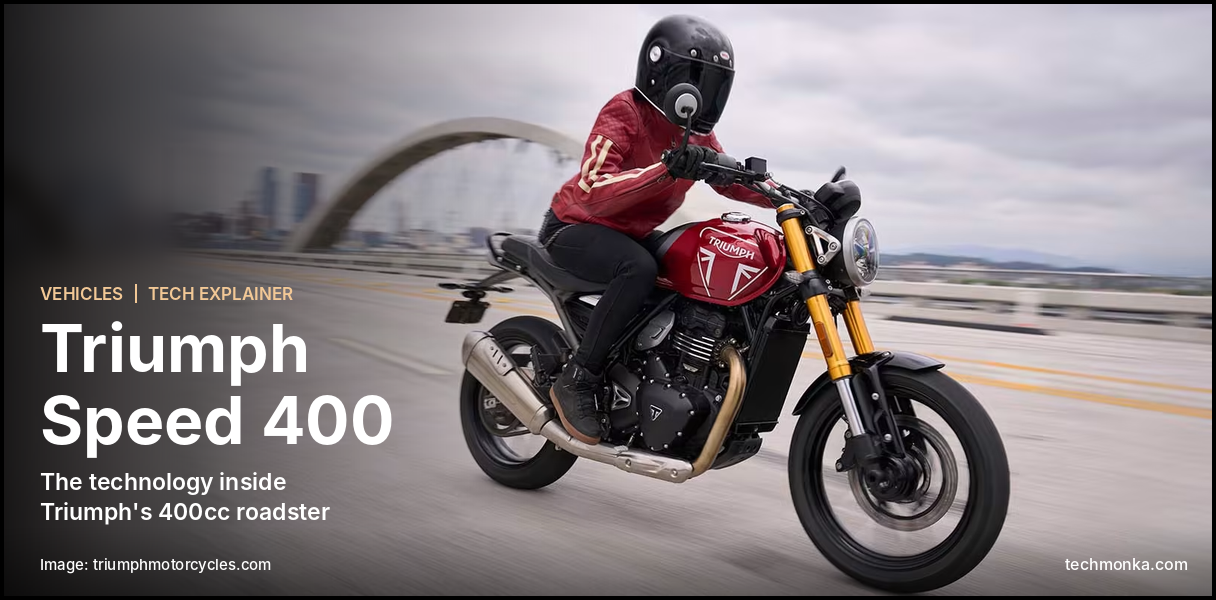
The Speed 400 is the cheapest way into a new Triumph, but under the classic tank and round headlight there is a modern liquid-cooled engine, a ride-by-wire throttle and traction control that many bikes of this size still go without.
Triumph unveiled the Speed 400 in London in June 2023 alongside the Scrambler 400 X, and it was the first bike to come out of the British firm’s partnership with India’s Bajaj Auto. According to a Bajaj Auto press release, more than 50,000 of the two models had been sold across more than 50 countries within a year of launch. Triumph’s 400cc family passed 100,000 sales in India alone by early 2026, according to Indian motoring site BikeAdvice.
The bike was designed by Triumph and Bajaj together over about five years and is built by Bajaj at its plant in Chakan, near Pune. It is sold in Europe, the UK, North America, Australia and much of Asia, and it fits the European A2 licence category, which makes it a common choice for newer riders. Its looks are borrowed from Triumph’s larger Speed Twin, but the technology is all new.
The engine
At the heart of the bike is a 398cc single-cylinder engine from a new family that Triumph calls the TR-Series. It is liquid-cooled, with double overhead camshafts and four valves, and Triumph quotes 40PS (39.5bhp) at 8,000rpm and 37.5Nm of torque at 6,500rpm. Those numbers put it near the top of its class, and they come with fuel consumption of 3.5 litres per 100km on the official European test, according to Triumph.
The engine is short-stroke, with an 89mm bore and a 64mm stroke, which lets it rev freely, and it runs a fairly high 12:1 compression ratio to get more power out of each drop of fuel. Triumph says the crankshaft has been weighted and balanced to give the right amount of inertia for smooth running at low speed, which matters on a bike that will spend much of its life in town traffic.
One of the more advanced parts of the design is the valvetrain. Instead of having the camshafts push directly on the valves, the Speed 400 uses small pivoting levers known as finger followers. These are lighter than conventional parts, so the engine has less mass to move back and forth thousands of times a minute, and Triumph gives them a diamond-like carbon (DLC) coating to cut friction. It is the kind of technology more often found on sports bikes, and it is one reason the engine is happy to rev.
Fuel is delivered by a Bosch electronic injection system, and the bike needs a service only every 16,000km (10,000 miles) or once a year, whichever comes first. That is a long interval for a small motorcycle and should help keep running costs down.
Ride-by-wire and traction control
The Speed 400 has a ride-by-wire throttle, which means there is no cable running from the twistgrip to the engine. A sensor measures how far the rider turns the grip and sends that information to the engine’s computer, which then opens the throttle using an electric motor.
This is what makes traction control possible. The system watches the speed of both wheels using the same sensors as the anti-lock brakes, and if the rear wheel starts to spin faster than the front, which usually means it has lost grip on a wet or slippery surface, the computer reduces power until the tyre grips again. Riders can switch the traction control off using the handlebar controls, which Triumph says is useful on loose surfaces like gravel where a little wheelspin can help.
There are no riding modes or cornering functions, and the Speed 400 has a single setting for throttle response. That keeps the bike simple, although it means riders who want the more advanced electronics of bigger Triumphs will need to look further up the range.
The torque-assist clutch
The clutch is one of the features owners tend to notice first. Triumph calls it a torque-assist clutch, and it is a wet, multi-plate design with what the industry calls slip-and-assist ramps built into it.
When the engine is driving the bike forward, the ramps help squeeze the clutch plates together. That allows Triumph to use lighter clutch springs, so the lever needs much less effort to pull, which makes a real difference in stop-start traffic. When the rider changes down a gear too quickly, the ramps work the other way and let the clutch slip slightly, which stops the rear wheel from hopping or locking up as the engine braking suddenly increases. The bike has a six-speed gearbox and a chain final drive.
Exhaust and sound
The exhaust has a stainless steel header pipe with a twin-skin design, meaning it has an inner and an outer wall. The gap between the two helps keep the outer pipe cooler and slows the blue and gold discolouration that often appears on single-wall pipes. According to Rider Magazine, part of the silencing is done by a primary silencer tucked out of sight under the bike, which allows the visible stainless silencer to stay short and neat.
Triumph says the engine has a rich and distinctive exhaust note, and the bike still has to meet Euro 5 emissions and noise rules, so the sound is tuned within tight limits. To hear it for yourself, watch our walkaround and sound test below.
Our walkaround and sound test of the Triumph Speed 400. Video: techmonka.com
Frame and suspension
The Speed 400 has its own tubular steel frame, which Triumph describes as a hybrid spine and perimeter design, with a rear subframe that is bolted on rather than welded. A bolt-on subframe is cheaper and easier to replace after a fall, and it is unusual on a bike in this price range. The swingarm is made from cast aluminium and has arms on both sides.
At the front are 43mm upside-down forks with 140mm of travel. Triumph uses a Big Piston design, where a larger damping piston inside the fork can control the movement of the wheel at lower oil pressure, which tends to give a smoother and more consistent ride over bumps. At the back is a single gas-charged shock with an external reservoir and 130mm of travel. Only the spring preload can be adjusted, so riders can make it firmer when carrying a passenger or luggage.
The bike weighs 170kg with fuel, according to Triumph, and the seat is 790mm from the ground, which should suit most riders. It rides on 17-inch cast aluminium wheels with 10 spokes and a 13-litre fuel tank. The full figures are listed on Triumph’s specification page.
Brakes and ABS
Stopping is handled by a single 300mm disc at the front, gripped by a four-piston radial caliper, and a 230mm disc at the rear with a floating caliper. A radial caliper is fixed to the fork with bolts that point towards the centre of the wheel rather than across it, which makes the mounting stiffer and gives the rider a more precise feel at the lever. The brake lines are braided, which means they expand less under pressure than ordinary rubber hoses.
Both wheels are covered by a Bosch two-channel anti-lock braking system, which stops either wheel from locking under hard braking. It is a conventional system rather than the lean-sensitive cornering ABS fitted to Triumph’s more expensive models.
Instruments, lighting and security
The dashboard mixes old and new. A large analogue speedometer sits in a round housing, and a small LCD screen inside it shows a digital rev counter, the gear you are in, fuel level and an estimate of the range left in the tank. Riders scroll through the information using a button on the handlebar. There is no Bluetooth or phone connection, and no navigation, even as an option.
There is a USB-C socket for charging a phone or sat nav, and the wiring and display are ready for Triumph’s accessory heated grips, so they can be added later without extra switches. All the lights are LED, including a headlight with a daytime running light and slim indicators.
For security, the key contains a chip that talks to an immobiliser, so the engine will not start without the right key. Triumph offers a two-year, unlimited mileage warranty in many markets.
Updates since launch
Triumph has kept the core of the bike the same in most markets since launch, with new paint schemes rather than technical changes. In India, a 2025 update fitted taller tyres with thicker sidewalls, added 10mm more foam to the seat and made the brake and clutch levers adjustable as standard, according to Autocar Professional.
The biggest change has also come in India. In April 2026 Triumph and Bajaj switched Indian bikes to a smaller 349cc version of the engine, which keeps the 89mm bore but uses a shorter 56.1mm stroke. According to Triumph’s Indian website, it makes 37PS at 8,500rpm and 32Nm of torque at 7,000rpm, and the bike weighs 179kg. The change followed a tax overhaul in India that puts a much higher rate on motorcycles above 350cc, and it allowed the price to drop to Rs 2.31 lakh, according to Rushlane. Buyers outside India still get the 398cc engine.
Price
In the UK the Speed 400 starts at £5,245, according to Triumph. Prices in Europe, North America and Australia vary by country, and buyers should check the local Triumph website for the latest figures.
Why it matters
Smaller motorcycles sell in huge numbers in Asia and are popular with new riders everywhere, and established brands have been teaming up with lower-cost manufacturers to compete for them. The Speed 400 shows how that can work. Triumph brings the design and engineering and Bajaj brings the factory and the scale, which means a bike with ride-by-wire, traction control and a slip-and-assist clutch can be sold at a price that would once only have bought a basic commuter.
The bike is not without compromises, and riders who want connectivity, riding modes or fully adjustable suspension will not find them here. But for a first big bike or an easy everyday machine, the Speed 400 packs more technology than its size and price suggest.
Frequently asked questions
How much power does the Triumph Speed 400 have?
The 398cc version sold in most markets makes 40PS (39.5bhp) at 8,000rpm and 37.5Nm of torque at 6,500rpm. The 349cc version sold in India since April 2026 makes 37PS and 32Nm.
Does the Triumph Speed 400 have traction control?
Yes. It has switchable traction control, made possible by its ride-by-wire throttle. It can be turned off for loose surfaces.
Is the Speed 400 suitable for an A2 licence?
Yes. It falls within the European A2 licence limits without needing to be restricted.
Where is the Triumph Speed 400 made?
It is built by Bajaj Auto at its factory in Chakan, near Pune in India, and was developed jointly by Triumph and Bajaj.
How often does the Speed 400 need servicing?
Every 16,000km (10,000 miles) or every 12 months, whichever comes first, according to Triumph.
Does the Speed 400 have Bluetooth?
No. The instruments do not connect to a phone and there is no navigation option, although there is a USB-C charging socket.

The TechMonka newsroom

Spotted an error? Tell us. TechMonka is editorially independent; no company mentioned paid for or reviewed this story.


Comments (0)