



 COPIED
Europe’s video game age rating body has raised some of the world’s most popular games to PEGI 16 because they sell paid random items. We look at how loot boxes work, why they keep being compared with casinos and how the rules differ from country to country.
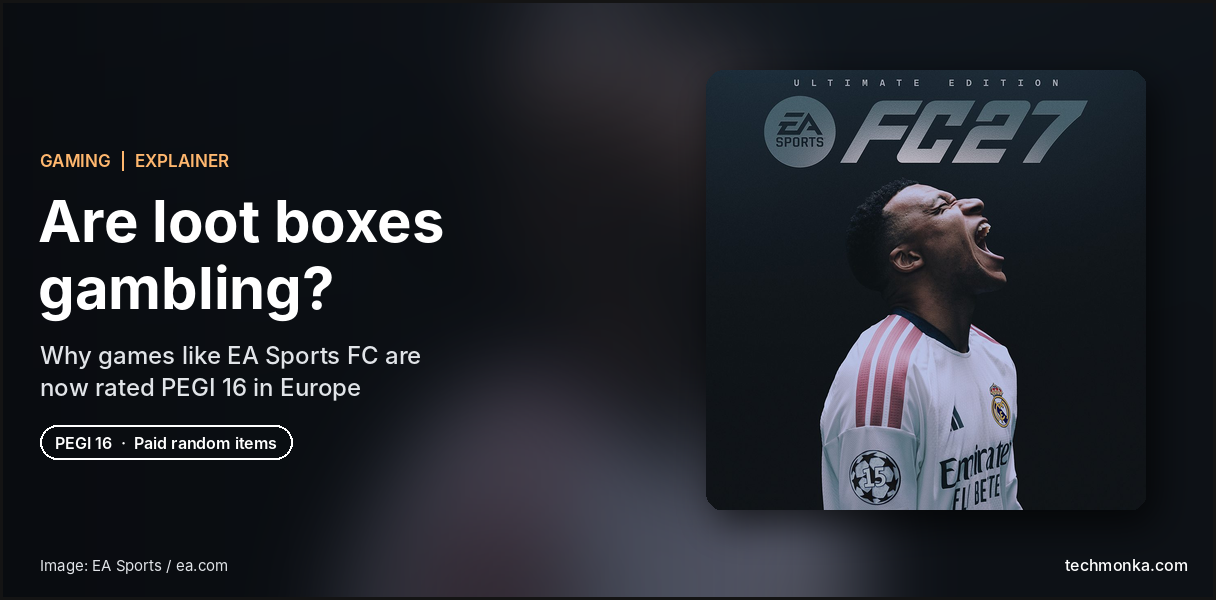
Parents who look up EA Sports FC or Pokémon Go on a European online store this month may notice that the age rating has changed. Since early October, PEGI, the system used across most of Europe and in the UK, has been moving digital games that sell loot boxes from PEGI 3, 7 or 12 up to PEGI 16, with a new label that reads “paid random items”.
Games already carrying the higher rating include EA Sports FC, Pokémon Go, Pokémon Trading Card Game Pocket, Mario Kart Tour, Zenless Zone Zero and Marvel Rivals, according to reports by VGC and Inven Global. The change does not ban anything, but it is the clearest signal yet that regulators see these mechanics as a close relative of the casino, even in games where nothing can be won in cash.
What is a loot box?
A loot box is a reward with a random outcome that players pay for, either with real money or with an in-game currency that was itself bought with real money. The player knows they will receive something but not what it will be, and the most valuable items are usually the rarest.
The idea takes different forms depending on the game. In EA Sports FC’s Ultimate Team mode players open packs of footballers, hoping for a highly rated star. In Counter-Strike 2 they buy a key to unlock a weapon case that might contain a rare knife. Many mobile games, especially those from Asia, use “gacha” systems where players spend currency on random draws for new characters, and some of these games show players the odds before they spend.
Loot boxes have become one of the main ways that free-to-play and live service games make money, because a small share of players spend heavily while most spend little or nothing.
Why are loot boxes compared to casinos?
The comparison starts with the technology. A loot box and an online slot machine both depend on a random number generator, a piece of software that decides the result the moment the player commits. Both also tend to wrap that result in a short burst of animation and sound, with the rarest outcomes getting the most dramatic reveal, and both often use a virtual currency that makes it harder to keep track of how much real money has been spent.
There are important differences, however. Licensed online casinos in regulated markets have to prove that their random number generators are fair through independent testing, publish the expected return to the player and check that customers are adults. Loot boxes have historically faced none of those requirements, although Apple and Google now require games on their app stores to disclose the odds of receiving each type of item.
The legal question usually turns on the prize. Most gambling laws only apply when a player can win “money or money’s worth”, and because loot box items generally cannot be cashed out, many regulators have concluded that they are not gambling in the legal sense. That argument becomes much weaker when the items can be sold for real money.
Counter-Strike and the real-world value of skins
Counter-Strike is the best-known example of loot box items with a cash value. Weapon skins from its cases can be sold on Valve’s Steam Community Market and on third-party websites, and some rare knives and gloves have changed hands for thousands of dollars.
That value led to a wave of unlicensed “skin gambling” sites, where players used skins as stakes on coin flips, roulette-style games and esports matches. In 2016 Valve said it would take action against sites that used its Steam login system to run gambling, after criticism that many users of these sites were teenagers.
How much these items behave like a financial market became clear in October 2025. Valve changed its trade-up system so that players could swap five top-tier skins for a guaranteed knife or pair of gloves, which had until then been some of the rarest items in the game. Prices for knives and gloves fell sharply, and the estimated value of the whole Counter-Strike 2 item market dropped from more than $6 billion to around $4 billion within days, according to figures from the tracking site PriceEmpire.
Valve has also changed how cases work in some countries. Players in Belgium and the Netherlands cannot open Counter-Strike cases, and in France the game shows players exactly what a case contains before they pay to open it.
How loot box rules differ around the world
There is no global rule on loot boxes, and countries have taken very different approaches.
Belgium
Belgium went furthest first. In 2018 its gambling regulator concluded that paid loot boxes in several games, including FIFA 18 and Counter-Strike: Global Offensive, broke the country’s gambling law, and some publishers withdrew them from sale in Belgium. Enforcement has been patchy, however, and a 2023 study by researcher Leon Y. Xiao found that 82 of the 100 highest-grossing iPhone games in Belgium still contained loot boxes.
Netherlands
The Netherlands took a tougher line at first and then reversed. The Dutch gambling authority fined Electronic Arts over the packs in FIFA Ultimate Team, but in 2022 the country’s highest administrative court, the Council of State, overturned the decision and ruled that the packs were not a standalone game of chance.
United Kingdom
The UK government decided in 2022 not to bring loot boxes under gambling law. In its response to a public call for evidence, it said that the industry should improve protections itself, including making sure that children cannot buy loot boxes without permission from a parent or guardian. The UK games industry body Ukie later published a set of principles for its members to follow.
Germany and the rest of Europe
Germany’s rating body, the USK, began taking in-game purchases and loot boxes into account in its age ratings in 2023 after the country’s youth protection law was updated. PEGI has now followed. Under its new criteria, which apply to new games submitted since June 2026, paid random items lead to a rating of PEGI 16, and in some cases PEGI 18. Games with NFTs or blockchain features are rated PEGI 18, while time-limited offers that pressure players to buy lead to at least PEGI 12. The October re-rating extends the loot box rule to existing digital games that are still on sale.
The European Union may go further. The European Commission is expected to propose a Digital Fairness Act in the last quarter of 2026, a law aimed at manipulative and addictive design in digital products, according to the European Parliament’s legislative tracker. Consumer groups have pressed for it to cover loot boxes and in-game currencies, although the final text has not yet been published.
Australia
Australia changed its classification rules in September 2024. Under the new system, new games with paid loot boxes receive at least an M rating, and games with simulated gambling, such as virtual casino games where no real money can be won, are classified R 18+.
Brazil
Brazil has introduced one of the strictest rules so far. Its new law protecting children online, known as ECA Digital, came into force in March 2026 and bans loot boxes in games aimed at or likely to be used by children and teenagers.
Asia and the United States
China and South Korea have focused on transparency. China has required games to publish loot box odds since 2017, and South Korea made odds disclosure a legal requirement in March 2024. In the United States there is no federal law on loot boxes, although several state bills have been proposed over the years.
What it means for players and parents
For most players the new PEGI ratings will change little day to day, because games already on a device will keep working as before. Their main effect is on information, since parents who check age ratings will now see a clear warning when a game sells random rewards.
PlayStation, Xbox, Nintendo Switch, iPhone and Android devices all include parental controls that can block purchases or set a monthly spending limit, and these tend to be more effective than relying on an age label alone. Checking the published odds in a game’s store or menu can also help players understand how unlikely the rarest items are.
Anyone who feels that spending on loot boxes, skins or any form of gambling is getting out of control can find free and confidential support through national helplines and charities in most countries, including GamCare in the UK.
Where gaming ends and gambling begins
For years the games industry has argued that loot boxes are closer to a pack of football stickers than a slot machine, because players always receive something and cannot win money. Regulators have increasingly answered that the way loot boxes are designed matters as much as the prize, particularly when children are among the players.
The direction of travel is towards more labelling, more disclosure and more age limits rather than outright bans. With the EU’s Digital Fairness Act still to come and more countries looking at Brazil’s approach, the line between video games and gambling is likely to keep moving for some time.
Frequently asked questions
Are loot boxes gambling?
In most countries they are not legally classed as gambling, because the items usually cannot be exchanged for money. Belgium is the main exception, and regulators elsewhere have raised age ratings or required odds disclosure because the mechanics are similar to gambling.
Why is EA Sports FC now rated PEGI 16?
PEGI now gives a default rating of PEGI 16 to games that sell paid random items. EA Sports FC’s Ultimate Team packs fall under that rule, so the digital versions of the games have been re-rated.
Are existing games affected by the new PEGI rules?
Yes, in part. The rules have applied to new games since June 2026, and since October PEGI has also been raising the ratings of existing digital games that contain paid random items.
Are Counter-Strike skins gambling?
Buying a key and opening a case is not regulated as gambling in most countries, but skins can be sold for real money and have been used as stakes on unlicensed gambling sites. Valve disables case opening in Belgium and the Netherlands.
Which countries have banned loot boxes?
Belgium treats paid loot boxes as illegal gambling, and Brazil has banned them in games likely to be used by children and teenagers. Most other countries rely on age ratings and odds disclosure instead.
Starting his career as a young journalist in Sheffield, UK, Andrew got tired of rain and moved to sunny Malta, where he started his iGaming career as a content writer in 2017.

Spotted an error? Tell us. TechMonka is editorially independent; no company mentioned paid for or reviewed this story.

Comments (0)