



 COPIED
ChatGPT was released by OpenAI as a “research preview” in November 2022, and less than four years later more than a billion people open it every week. Nearly half of American adults say they have used it and advertisers are now paying to appear inside it. No consumer technology before it has spread this quickly.
Its lead over rival chatbots is getting smaller, however. ChatGPT is still adding users, but Gemini and Claude are growing faster, and ChatGPT’s share of AI chatbot traffic has fallen sharply over the past year. The numbers below show both of those trends side by side.
Every figure on this page comes directly from the organisation that produced it. Much of it is taken from OpenAI’s own posts and research, and because those numbers are reported by the company itself we label them that way. The independent figures come from Pew Research Center surveys, Similarweb traffic data, the US Census Bureau, the Reuters Institute, Stack Overflow and Ofcom, and we never take numbers from other statistics roundups.
Key Takeaways
- More than 1.2 billion people use ChatGPT every week (OpenAI, Oct 2026).
- ChatGPT reached 1 million users in five days and 100 million in two months (OpenAI, Jul 2025).
- 44% of US adults have used ChatGPT, up from 18% in 2023 (Pew Research Center, Jun 2026).
- ChatGPT’s share of AI chatbot web visits fell from about 76% to roughly 53% in a year, between June 2025 and May 2026 (Similarweb, Jul 2026).
- More than 50 million people pay for a consumer ChatGPT plan (OpenAI, Feb 2026).
- OpenAI’s annualised revenue grew from $2 billion in 2023 to more than $20 billion in 2025 (OpenAI, Jan 2026).
- ChatGPT Ads reached a $1 billion annualised revenue run rate in under 200 days (OpenAI, Aug 2026).
- More than 70% of ChatGPT messages have nothing to do with work (National Bureau of Economic Research, Sep 2025).
- Only 4.2% of ChatGPT messages are about computer programming (National Bureau of Economic Research, Sep 2025).
- Men and women in the US now use ChatGPT in identical numbers, at 44% each (Pew Research Center, Oct 2026).
- 54% of US teens have used AI chatbots to help with schoolwork (Pew Research Center, Feb 2026).
- Only 1% of people say an AI chatbot is their main source of news (Reuters Institute, Jun 2026).
- 95% of ChatGPT users still use Google as well (Similarweb, Aug 2026).
How many people use ChatGPT?
ChatGPT has grown faster than any consumer product before it. OpenAI’s announcements need to be read carefully, however, because the company uses “people who use ChatGPT” and “users of our products” to mean different things, and only the first of those is a figure for ChatGPT itself.
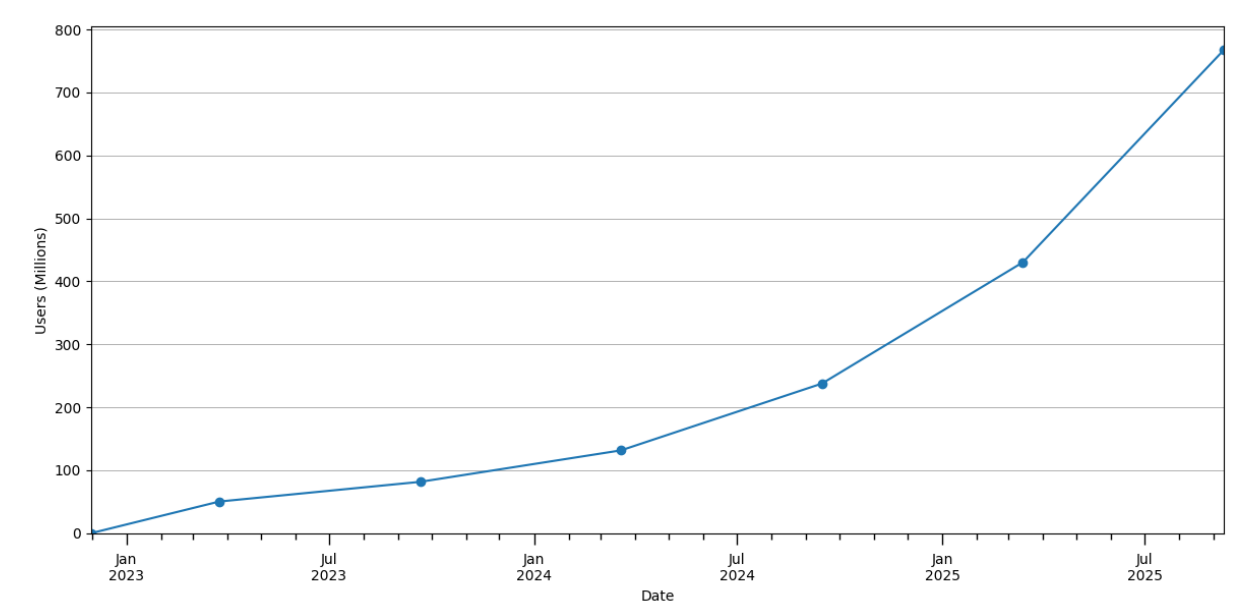
Figure 1: ChatGPT’s weekly user numbers rose slowly through 2023 before climbing steeply from late 2024. Its growth sped up as it got bigger, which is the reverse of what usually happens with apps. Source: National Bureau of Economic Research, How People Use ChatGPT, Figure 3, Sep 2025. Chart published by the source and cropped from the paper’s PDF, captured 27 Oct 2026.
How many weekly users does ChatGPT have in 2026?
ChatGPT now has more than a billion users a week, and the number has gone up every time OpenAI has given an update this year.
- In April 2026, OpenAI put ChatGPT at 900 million weekly users (OpenAI, Apr 2026).
- In November 2025 the figure was more than 800 million (OpenAI, Nov 2025).
In its September 2026 investor note, OpenAI said its products reach “more than one billion weekly active users and 2.5 million businesses” (OpenAI, Sep 2026). That total covers ChatGPT, Codex and the API together, so it should not be read as a figure for ChatGPT alone.
How fast did ChatGPT grow?
ChatGPT grew faster than any app before it, according to both OpenAI’s own figures and independent research.
- It had more than 100 million logged-in weekly users after one year and almost 350 million after two (National Bureau of Economic Research, Sep 2025).
- By July 2025 ChatGPT had 700 million weekly users, or about 10% of the world’s adults (National Bureau of Economic Research, Sep 2025).
How many messages do people send ChatGPT?
People send ChatGPT billions of messages every day, and they tend to send more the longer they have been using it.
- ChatGPT users sent more than 2.5 billion messages a day in July 2025, including more than 330 million a day from the US (OpenAI, Jul 2025).
- The number of messages sent grew more than fivefold between July 2024 and July 2025 (National Bureau of Economic Research, Sep 2025).
- Six months after signing up, people on individual plans were sending about 50% more messages a day than in their first month and had tried about twice as many kinds of task (OpenAI, Sep 2026).
How many people pay for ChatGPT, and what does it cost?
Only a small share of ChatGPT users pay for it, although that share has been growing.
- January and February 2026 were on track to be the biggest months for new subscribers in ChatGPT’s history (OpenAI, Feb 2026).
- ChatGPT Go costs $8 a month in the US. It launched in India in August 2025 and has since reached 170 more countries, which makes it OpenAI’s fastest-growing plan (OpenAI, Jan 2026).
- ChatGPT plans can now be used inside 16 partner tools, among them Notion, Vercel and Cognition’s Devin (OpenAI, Sep 2026).
- The Pro 500 plan, launched at DevDay 2026, gives 25 times the usage allowance of ChatGPT Plus (OpenAI, Sep 2026).
Who uses ChatGPT?
In its early days most of ChatGPT’s users were young, male and technically minded. That is no longer the case, and independent surveys now back up what OpenAI’s own data has been showing for some time.
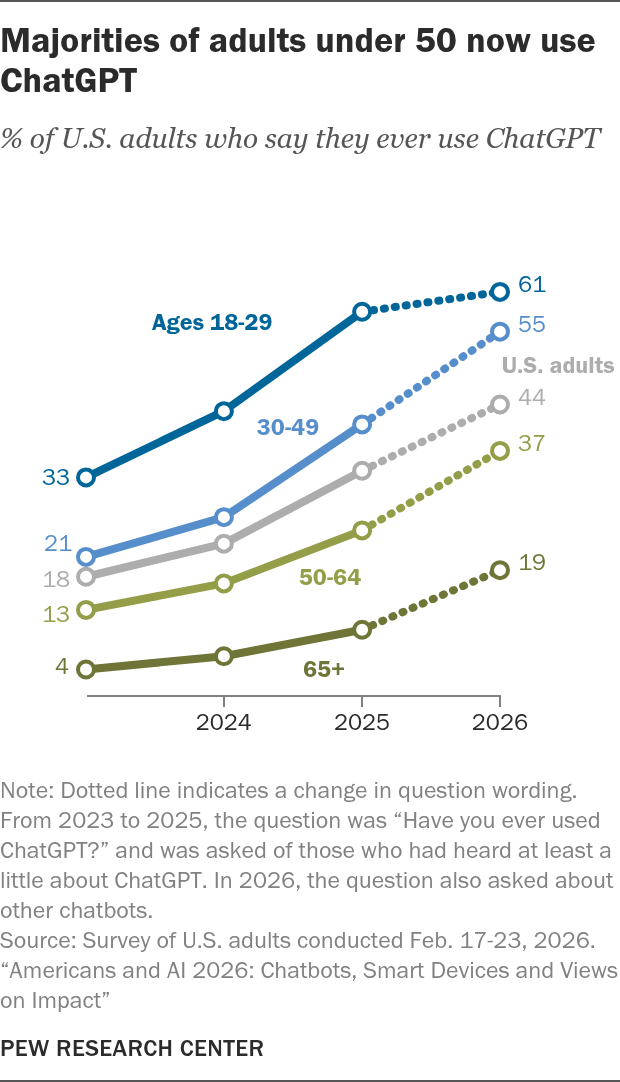
Figure 2: Use of ChatGPT has at least doubled in every age group since 2023, and the fastest growth is now among people over 30. The dotted lines mark a change to the wording of Pew’s question in 2026. Source: Pew Research Center, Majorities of adults under 50 now use ChatGPT, Feb 2026. Chart published by the source, captured 27 Oct 2026.
What share of Americans use ChatGPT?
Close to half of American adults have now used ChatGPT, and the share has gone up every year.
- 34% of US adults had used ChatGPT by early 2025, about double the 2023 figure (Pew Research Center, Jun 2025).
- About half of US adults now use at least one AI chatbot (Pew Research Center, Jun 2026).
- In the UK, ChatGPT had 1.8 billion visits in the first eight months of 2025, up from 368 million in the same period of 2024 (Ofcom, Dec 2025).
How old are ChatGPT users?
Younger adults are still the most likely to use ChatGPT, but older adults are the ones catching up fastest.
- Adults under 50 are about twice as likely as those aged 50 and over to use ChatGPT, at 57% against 28% (Pew Research Center, Jun 2026).
- 61% of 18 to 29-year-olds use ChatGPT, compared with 19% of over-65s (Pew Research Center, Jun 2026).
- Nearly half of all messages from adults were sent by users under 26 (National Bureau of Economic Research, Sep 2025).
- Users over 35 now account for “a 5% higher share” of ChatGPT messages than they did a year earlier (OpenAI, Aug 2026).
- In France and Czechia, the share of messages from over-35s rose by more than 10 percentage points in a year (OpenAI, Aug 2026).
Is there still a gender gap?
The gender gap has closed for ChatGPT itself, although a small one remains for AI chatbots in general.
- Soon after launch, about 80% of active users had typically masculine first names. By June 2025 that share had fallen to 48% (National Bureau of Economic Research, Sep 2025).
- In early 2026, users with typically feminine names made up more than half of the users whose gender OpenAI could infer (OpenAI, May 2026).
- 50% of US men and 47% of women use an AI chatbot of some kind, up from 39% and 28% in 2024 (Pew Research Center, Oct 2026).
- Men are still more likely to use a chatbot every day, at 27% against 20% for women (Pew Research Center, Oct 2026).
Which countries use ChatGPT most?
ChatGPT is now growing fastest outside the countries that adopted it first.
- OpenAI ranks 144 countries by the number of ChatGPT messages sent per person, and updates the list every quarter (OpenAI, Aug 2026).
- ChatGPT adoption grew faster in lower-income countries than in richer ones between May 2024 and May 2025 (National Bureau of Economic Research, Sep 2025).
- The fastest-growing business customer bases are in Australia, Brazil, the Netherlands and France, each up more than 140% year on year (OpenAI, Dec 2025).
What do people use ChatGPT for?
The popular image of ChatGPT is of students cheating on homework and developers writing code, but the data tells a different story. Most people treat it as an adviser, and ask it what to do, how to go about something or how to word it.
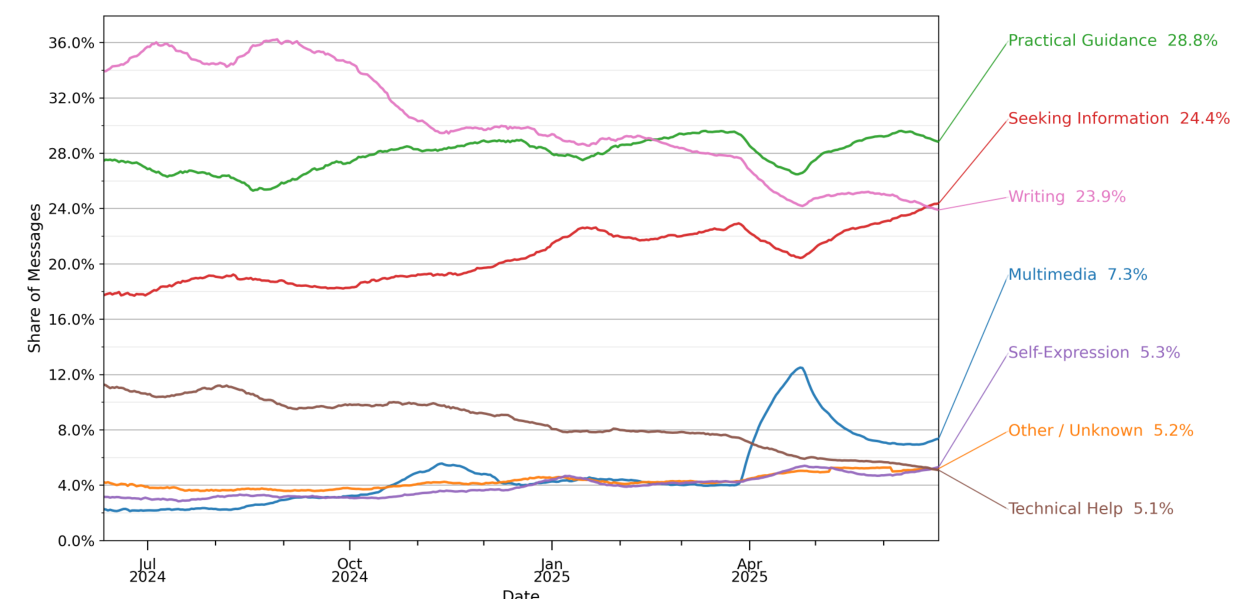
Figure 3: Practical guidance overtook writing as the most common use of ChatGPT around the start of 2025, while the share of people looking for information rose steadily. Multimedia requests briefly jumped to about 12% in spring 2025 before falling back. Source: National Bureau of Economic Research, How People Use ChatGPT, Figure 7, Jun 2025. Chart published by the source and cropped from the paper’s PDF, captured 27 Oct 2026.
Is ChatGPT used more for work or personal tasks?
Most ChatGPT use is personal rather than work-related, and the personal share has been growing.
- Practical Guidance, Seeking Information and Writing together make up nearly 80% of all ChatGPT conversations (National Bureau of Economic Research, Sep 2025).
- Work use is more common among better-educated users. 37% of messages from users without a bachelor’s degree are work-related, compared with 48% from users with a graduate education (National Bureau of Economic Research, Sep 2025).
- 25% of US adults use AI chatbots for fun or entertainment (Pew Research Center, Jun 2026).
What are the most common things people ask ChatGPT?
People mostly turn to ChatGPT for advice and explanations, and far fewer use it to write code.
- About 49% of messages ask for information or advice, while 40% ask ChatGPT to carry out a task and 11% express a view or feeling (National Bureau of Economic Research, Sep 2025).
- About two-thirds of writing requests ask ChatGPT to work on the user’s own text, by editing, critiquing, summarising or translating it, rather than to write something new (National Bureau of Economic Research, Sep 2025).
- Tutoring and teaching make up 10.2% of all messages (National Bureau of Economic Research, Sep 2025).
- Only 1.9% of messages are about relationships and personal reflection (National Bureau of Economic Research, Sep 2025).
- 42% of US adults have used AI chatbots to search for information (Pew Research Center, Jun 2026).
What’s growing fastest?
Requests for images and video are the fastest-growing use of ChatGPT, while news remains only a small part of what people ask chatbots about.
- Multimedia requests reached 7.8% of all messages in the second quarter of 2026, after ChatGPT Images 2.0 launched in April (OpenAI, Aug 2026).
- Weekly use of AI chatbots for news rose from 7% to 10% across the markets surveyed (Reuters Institute, Jun 2026). This figure covers all chatbots and not just ChatGPT.
- The youngest age group is the most likely to use chatbots for news, at 17% (Reuters Institute, Jun 2026).
- 8% of US adults are using AI chatbots to find information about the 2026 elections (Pew Research Center, Oct 2026).
How many ChatGPT conversations involve mental health?
Only a small share of users have these conversations, but at ChatGPT’s scale that still adds up to a large number of people. OpenAI’s own estimates are listed below. If you or someone you know is struggling, you can call or text 988 in the US, or contact Samaritans on 116 123 in the UK.
- About 0.15% of weekly active users have conversations that include explicit indicators of possible suicidal planning or intent (OpenAI, Oct 2025).
- About 0.07% of weekly users show possible signs of mental health emergencies related to psychosis or mania (OpenAI, Oct 2025).
- OpenAI worked with more than 170 mental health experts and says it has cut the number of responses that fall short of its intended behaviour by 65 to 80% (OpenAI, Oct 2025).
OpenAI describes these figures as initial estimates, because conversations like these are rare and difficult to measure. They were also taken when ChatGPT had far fewer users than it does today.
How is ChatGPT used at work and in school?
Work is where ChatGPT turns from a habit into a business for OpenAI. Most of the figures on time saved come from OpenAI’s own customers, so we have set them alongside independent data from the US government and from survey organisations.
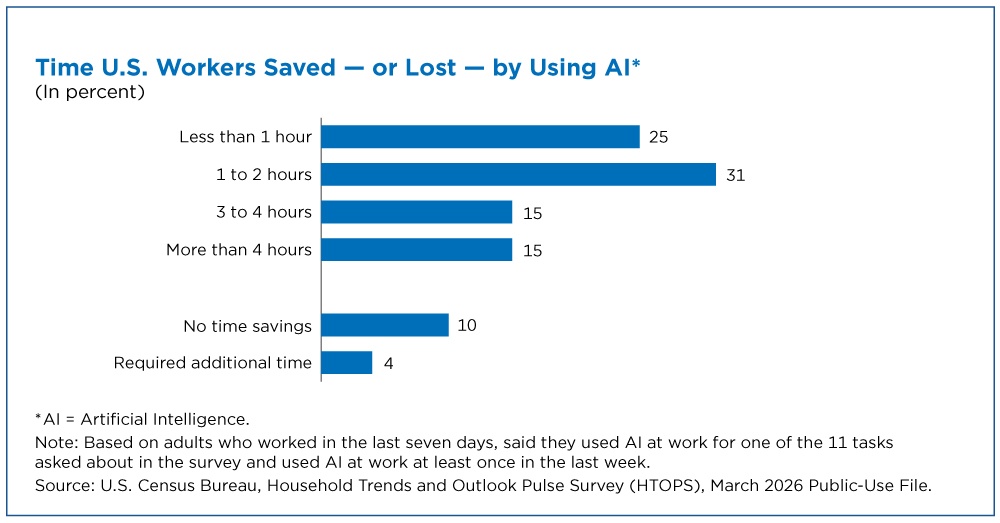
Figure 4: This government survey offers an independent check on claims about AI and productivity. Most US workers who had used AI in the previous week said it saved them time, most often between one and two hours, while a small minority said it slowed them down. The figures cover all AI tools rather than ChatGPT alone. Source: U.S. Census Bureau, Household Trends and Outlook Pulse Survey, Mar 2026. Chart published by the source, captured 27 Oct 2026.
How many businesses use ChatGPT?
Businesses now pay for millions of ChatGPT seats, and this side of OpenAI is growing faster than the consumer side.
- More than 9 million paying business users use ChatGPT for work (OpenAI, Feb 2026).
- OpenAI passed 1 million business customers in November 2025, and ChatGPT Enterprise seats were up 9x year on year (OpenAI, Nov 2025).
- Weekly messages in ChatGPT Enterprise grew about 8x in a year, while use of Projects and Custom GPTs grew 19x (OpenAI, Dec 2025).
- Enterprise now makes up more than 40% of OpenAI’s revenue and is on track to match consumer revenue by the end of 2026 (OpenAI, Apr 2026).
- For comparison, 19.8% of all US businesses were using AI of any kind in early May 2026 (U.S. Census Bureau, May 2026).
- Among US firms with 250 or more employees, 37% use AI (U.S. Census Bureau, May 2026).
- The information sector has the highest AI use of any US industry, at 39.7% of businesses (U.S. Census Bureau, May 2026).
- Between 20% and 23% of US businesses expect to be using AI within six months (U.S. Census Bureau, May 2026).
Does ChatGPT actually save workers time?
OpenAI’s business customers say that it does, and government data broadly agrees with them.
- ChatGPT Enterprise users report saving 40 to 60 minutes a day, and heavy users more than 10 hours a week. These figures are self-reported and come from OpenAI’s own survey of 9,000 workers (OpenAI, Dec 2025).
- 75% of the enterprise users surveyed say they can now complete tasks they previously could not (OpenAI, Dec 2025).
- About 56% of US workers have used AI on the job for at least one of 11 common tasks (U.S. Census Bureau, Aug 2026).
- 31% of US workers who used AI in the past week said it saved them one to two hours (U.S. Census Bureau, Aug 2026).
- 4% said AI made their work take longer (U.S. Census Bureau, Aug 2026).
- 38% of employed US adults use chatbots for work tasks (Pew Research Center, Jun 2026).
- Looking at ChatGPT alone, 28% of employed US adults used it for work in early 2025, up 20 percentage points from 2023 (Pew Research Center, Jun 2025).
- Writing accounts for 40% of work-related ChatGPT messages (National Bureau of Economic Research, Sep 2025).
- About 56% of work-related ChatGPT messages ask it to do a task rather than answer a question (National Bureau of Economic Research, Sep 2025).
If you are thinking about which skills will keep their value as these tools spread, our guide What to Study When AI Changes Everything looks at where to focus.
How many developers use ChatGPT and Codex?
Most developers now use a general AI chat tool at work, but far fewer use OpenAI’s own coding agent.
- 62.5% of developers use general-purpose AI chat tools at work, while 17.2% use no AI tools at all (Stack Overflow, Oct 2026).
- 65.9% of developers use AI coding assistants or agents at work (Stack Overflow, Oct 2026).
- Among developers who use coding agents, 29.5% used OpenAI Codex in the past year, compared with 65.5% for Claude Code and 58.7% for GitHub Copilot (Stack Overflow, Oct 2026).
- 48% of developers trust AI when they can easily check its answers (Stack Overflow, Oct 2026).
- Codex reached 3 million weekly active users in April 2026, and OpenAI’s APIs now process more than 15 billion tokens a minute (OpenAI, Apr 2026).
- OpenAI’s new Ultrafast tier generates up to 300 tokens a second in Codex, which is up to 8x faster than the standard tier (OpenAI, Sep 2026).
How do students use ChatGPT?
Students use ChatGPT heavily, and many teenagers believe that cheating with AI is common at their school.
- 26% of US teens used ChatGPT for schoolwork in 2024, double the 13% recorded in 2023 (Pew Research Center, Jan 2025).
- 79% of US teens had heard of ChatGPT in 2024, up from 67% in 2023 (Pew Research Center, Jan 2025).
- One in ten US teens does all or most of their schoolwork with help from chatbots (Pew Research Center, Feb 2026).
- 59% of teens think using AI to cheat happens at least somewhat often at their school (Pew Research Center, Feb 2026).
- 26% of US adults had used ChatGPT to learn something new by early 2025, up from 8% in 2023 (Pew Research Center, Jun 2025).
How does OpenAI make money from ChatGPT?
For most of its life ChatGPT was a subscription product with a free tier attached. In 2026 it also became an advertising platform, and that changes the part the free tier plays in OpenAI’s business.
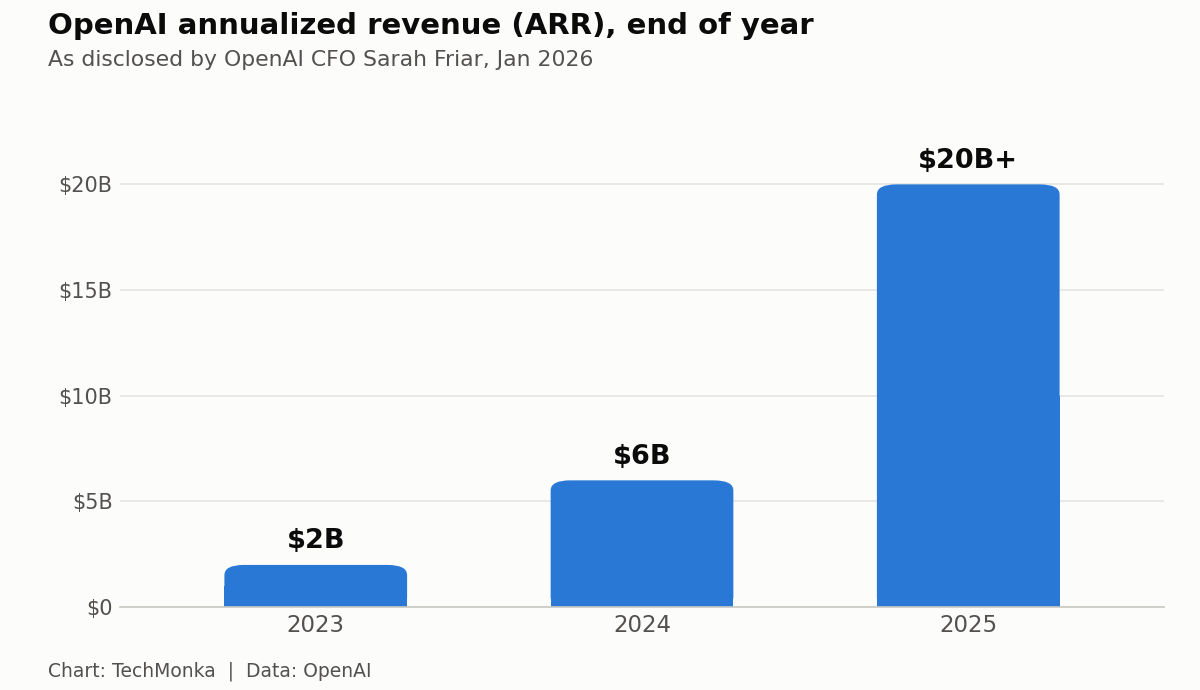
Figure 5: OpenAI’s revenue roughly tripled every year between 2023 and 2025. These are the most recent revenue figures that OpenAI has published itself. Source: OpenAI, A business that scales with the value of intelligence, Jan 2026. Chart built by TechMonka from the figures in the post, which does not include a chart of its own, 27 Oct 2026.
How much revenue does OpenAI make?
OpenAI’s revenue runs into the billions, and it has grown in step with the amount of computing power the company has been able to get hold of.
- OpenAI’s computing capacity grew from 0.2 GW in 2023 to 0.6 GW in 2024 and about 1.9 GW in 2025, following the same curve as its revenue (OpenAI, Jan 2026).
- ChatGPT for Work had more than 7 million seats in November 2025, up 40% in two months (OpenAI, Nov 2025).
Newspapers have reported revenue run rates for 2026 of between $40 billion and $70 billion, citing unnamed sources. OpenAI has not published those figures and the reports do not agree with one another, so we have left them out.
How big is ChatGPT advertising?
Advertising only arrived on ChatGPT this year, but it has already become a billion-dollar business for OpenAI.
- More than 100,000 advertisers have run campaigns on ChatGPT in the eight months since ads launched (OpenAI, Oct 2026).
- ChatGPT Ads are now available in 89 countries, and only Free and Go users see them (OpenAI, Oct 2026).
- ChatGPT Ads works with more than 50 technology and measurement partners (OpenAI, Aug 2026).
How much is OpenAI worth?
OpenAI is now valued at more than most publicly listed companies.
- OpenAI raised $110 billion at a $730 billion pre-money valuation, including $50 billion from Amazon and $30 billion each from SoftBank and NVIDIA (OpenAI, Feb 2026).
- After that round, the OpenAI Foundation’s stake in OpenAI Group was worth more than $180 billion (OpenAI, Feb 2026).
- Microsoft holds about 27% of OpenAI Group PBC, a stake valued at about $135 billion when the deal was agreed (Microsoft, Oct 2025).
- As part of the same deal, OpenAI committed to buying an extra $250 billion of Microsoft Azure cloud services (Microsoft, Oct 2025).
How does ChatGPT compare with Gemini, Claude and other chatbots?
ChatGPT is still well ahead of every rival, but it is losing market share for the first time. That is happening because the other chatbots are growing faster, and not because ChatGPT itself is shrinking.
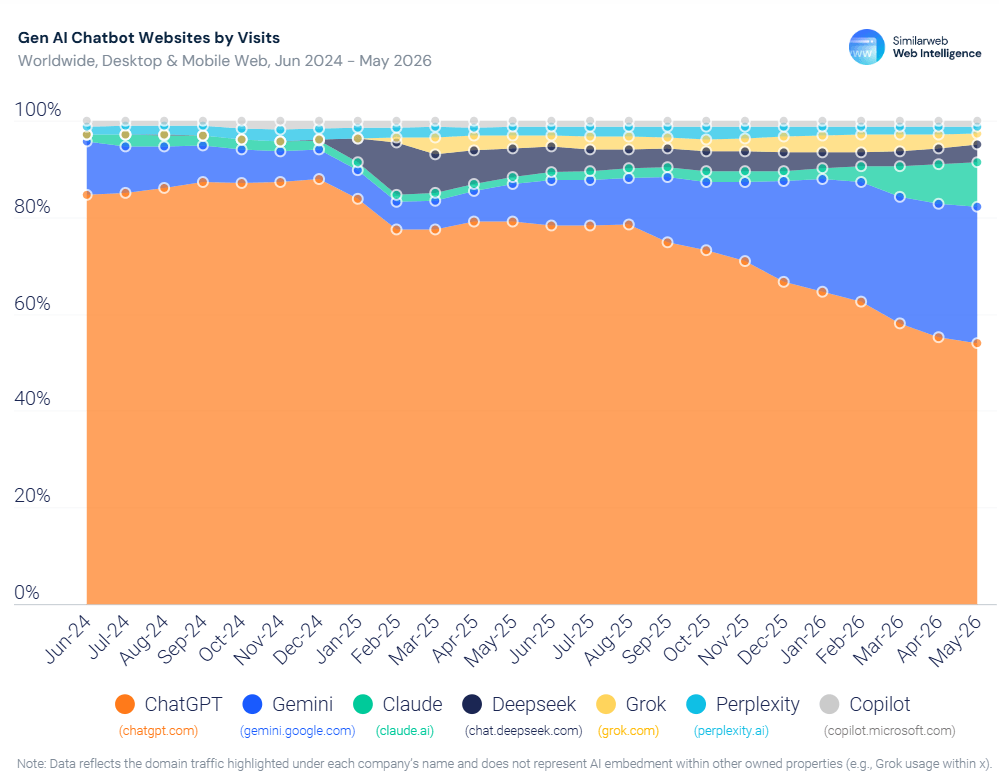
Figure 6: ChatGPT accounted for more than 80% of AI chatbot web traffic throughout 2024. Since the middle of 2025, Gemini (blue) and Claude (green) have taken a growing share. The chart covers website visits only and does not include the mobile apps. Source: Similarweb, AI Search Stats 2026, May 2026. Chart published by the source, captured 27 Oct 2026.
What is ChatGPT’s market share?
ChatGPT now accounts for about half of all AI chatbot web traffic, down from around three-quarters a year earlier.
- Gemini’s share of generative AI web visits rose from under 9% to around 27 to 28% between June 2025 and May 2026 (Similarweb, Jul 2026).
- Claude’s share rose from about 2% to close to 9% over the same period (Similarweb, Jul 2026).
- Worldwide visits to generative AI platforms reached 9.5 billion a month in May 2026, up 70% year on year (Similarweb, Aug 2026).
Is ChatGPT still the most-used chatbot?
ChatGPT remains the most-used chatbot by a wide margin, whichever measure you look at.
- ChatGPT averaged about 5.7 billion website visits a month between June 2025 and May 2026, up 53% year on year (Similarweb, Sep 2026).
- That is more than 17 times Claude’s 331 million monthly visits, although Claude’s traffic grew 319% over the same period (Similarweb, Sep 2026).
- ChatGPT’s US app stickiness averaged 40% over the year, the highest of any AI app that Similarweb tracks (Similarweb, Sep 2026).
- On desktop in the US, people send an average of 5.0 prompts per ChatGPT session, compared with 5.6 on Claude (Similarweb, Sep 2026).
- In the US, 24% of adults use Gemini, 17% use Copilot, 14% use Meta AI, 8% use Grok and 6% use Claude (Pew Research Center, Jun 2026).
Is AI replacing Google search?
AI has not replaced Google so far, and for most people ChatGPT is something they use alongside search rather than instead of it.
- Google Search is used by 82% of UK adults and handles about 3 billion searches a month in the UK (Ofcom, Dec 2025).
- The share of ChatGPT prompts that include a citation to a website rose from about 1.6% in June 2025 to 6.8% by May 2026 (Similarweb, Aug 2026).
- Only 4% of people always or often click through to sources from AI chatbots, compared with 19% from search engines (Reuters Institute, Jun 2026).
- 20% of people trust news from AI chatbots (Reuters Institute, Jun 2026).
Methodology and Sources
All of the statistics on this page come from the organisations that produced them rather than from other statistics roundups. Many are taken from OpenAI’s own announcements and research, and because these are reported by the company itself we label them that way. We also draw on a National Bureau of Economic Research working paper written by economists from OpenAI, Harvard and Duke, on surveys by the Pew Research Center and on traffic data from Similarweb. The remaining figures come from the US Census Bureau, the Reuters Institute for the Study of Journalism, the Stack Overflow Developer Survey, Ofcom and Microsoft.
Weekly users, the share of people who tell surveys they have “ever used” ChatGPT and shares of website visits all measure different things, so we never combine them into a single figure. Where OpenAI has not published a number, as with its 2026 revenue, we leave it out rather than repeat estimates from the press. Some openai.com pages block automated access, and in those cases we read Internet Archive copies of the same URL. This page is updated every month.
Glossary
- WAU / weekly users: people who used ChatGPT at least once in a given week.
- ARR / annualised revenue run rate: one month’s revenue multiplied by 12.
- Consumer subscriber: someone paying for ChatGPT Go, Plus or Pro. Business seats are not included.
- ChatGPT Enterprise / Business: ChatGPT plans sold to organisations.
- Codex: OpenAI’s coding agent.
- API: application programming interface, the way developers build OpenAI’s models into their own apps.
- Tokens: the chunks of text that AI models read and write. A token is roughly three-quarters of a word.
- GW (gigawatt): the unit OpenAI uses to measure its computing capacity.
- Generative AI: AI that creates text, images, audio or code.
- NBER: the National Bureau of Economic Research, a US non-profit that publishes economics research.
Sources
- OpenAI, ChatGPT Ads expands to 26 new countries (Oct 2026)
- OpenAI, DevDay 2026 Recap (Sep 2026)
- OpenAI, The Work Now Within Reach (Sep 2026)
- OpenAI, A milestone in expanding access to AI (Aug 2026)
- OpenAI, From asking to doing: How the world is putting ChatGPT to work (Aug 2026)
- OpenAI, How ChatGPT adoption broadened in early 2026 (May 2026)
- OpenAI, The next phase of enterprise AI (Apr 2026)
- OpenAI, Scaling AI for everyone (Feb 2026)
- OpenAI, A business that scales with the value of intelligence (Jan 2026)
- OpenAI, Introducing ChatGPT Go, now available worldwide (Jan 2026)
- OpenAI, The state of enterprise AI (Dec 2025)
- OpenAI, 1 million business customers (Nov 2025)
- OpenAI, Strengthening ChatGPT’s responses in sensitive conversations (Oct 2025)
- OpenAI, OpenAI’s new economic analysis (Jul 2025)
- National Bureau of Economic Research, How People Use ChatGPT, Working Paper 34255 (Chatterji, Cunningham, Deming, Hitzig, Ong, Shan, Wadman), Sep 2025
- Pew Research Center, Americans and AI 2026: Chatbots, Smart Devices and Views on Impact (Jun 2026)
- Pew Research Center, Majorities of adults under 50 now use ChatGPT (Jun 2026)
- Pew Research Center, Americans report using ChatGPT far more than other chatbots (Jun 2026)
- Pew Research Center, The Gender Gap in AI (Oct 2026)
- Pew Research Center, Few Americans say they are asking AI chatbots for 2026 election information (Oct 2026)
- Pew Research Center, How Teens Use and View AI (Feb 2026)
- Pew Research Center, 34% of US adults have used ChatGPT (Jun 2025)
- Pew Research Center, About a quarter of US teens have used ChatGPT for schoolwork (Jan 2025)
- Similarweb, AI Search Stats 2026 (Jul 2026)
- Similarweb, Claude vs. ChatGPT: 2026 Data Comparison (Sep 2026)
- Similarweb, Is AI Replacing Search? What the 2026 Numbers Reveal (Aug 2026)
- U.S. Census Bureau, Large Firms With at Least 20 Employees Biggest AI Users (May 2026)
- U.S. Census Bureau, About a Third of Workers Who Used AI in the Last Week Said They Completed Tasks One to Two Hours Faster (Aug 2026)
- Reuters Institute for the Study of Journalism, Digital News Report 2026: Emerging uses of AI chatbots for news (Jun 2026)
- Stack Overflow, 2026 Developer Survey: AI (Oct 2026)
- Ofcom, From apps to AI search: how the UK goes online in 2025 (Online Nation 2025), Dec 2025
- Microsoft, The next chapter of the Microsoft-OpenAI partnership (Oct 2025)

The TechMonka newsroom

Spotted an error? Tell us. TechMonka is editorially independent; no company mentioned paid for or reviewed this story.



Comments (0)